
How to Choose a Hotel RCU
Choose a hotel RCU by project type first: new builds favour wired RS-485 / Modbus or KNX for low latency and robustness; occupied renovations favour wireless BLE Mesh or Zigbee to avoid re-cabling entirely. Then size the relay channels (HOTEKEY offers 4 / 8 / 12 / 17 channels at 16A), confirm PMS integration, check certifications and spare-part supply, and model the cost against energy savings. HOTEKEY has delivered 130,000+ guest rooms and connects 282 hotels / 45,000+ rooms to HOTEKEY Cloud.
This checklist pairs with our RCU selection guide (deeper buying detail) and the RCU vs smart-home hub comparison — read those once you have a shortlist.
Step 1 — New Build or Renovation First
The single decision that drives everything else is whether you are wiring a fresh building or retrofitting occupied rooms.
| Factor | New build | Renovation / occupied |
|---|---|---|
| Cabling | Structured cabling planned in construction | Avoid opening walls; minimise downtime |
| Recommended | Wired RS-485 / Modbus or KNX | Wireless BLE Mesh or Zigbee |
| Cost driver | Cabling labour during build | Device count, no re-cabling |
Many projects use a hybrid: a wired backbone in public areas plus wireless zones in renovated room floors. HOTEKEY has delivered 92-room and 121-room BLE Mesh retrofits without stopping operations.
Step 2 — Pick the Communication Protocol
Match the protocol to the building and the operations team's comfort:
- RS-485 / Modbus — mature, low-cost, strong anti-interference; ideal for new builds with structured cabling.
- KNX — open standard, best-in-class interoperability for large, long-life buildings.
- BLE Mesh — no new wiring, fast retrofit, good for room-level control.
- Zigbee — low-power wireless alternative, similar retrofit profile.
Gateways bridge any of these to TCP/IP / MQTT and to the PMS, so protocol choice does not lock you out of cloud features.
Step 3 — Size Relay Channels and Ratings
Count the loads you want the RCU to switch per room: lighting circuits, AC (via FCU module), curtains, service calls and scene control. HOTEKEY RCU modules scale as 4 / 8 / 12 / 17 relay channels at 16A, with 0-10V dimmers, dry-contact modules and FCU modules so one architecture covers a compact room and a full suite floor.
Rule of thumb: a standard room needs 8-12 channels; a suite with multiple lighting zones and FCU units trends toward 12-17. Oversize by one step so future loads (e.g. an added curtain track) do not force a controller swap.
Step 4 — Confirm PMS Integration
At check-in the PMS should tell the RCU the room is occupied and run the welcome scene; at check-out it should switch to energy-saving mode and sync room status (cleaning, fault) back to the front desk in real time. Confirm the RCU supports your PMS via TCP/IP or serial (RS-485 / Modbus) through a gateway, and ask for a reference deployment on the same PMS brand.
Step 5 — Certifications and After-Sales
For export and for safe operation, verify CE / RoHS / CCC (and any regional marks for your market) before purchase. Equally important is the supply chain: confirm spare-part lead times, local technical support, and whether the vendor offers OTA configuration so a fault can be diagnosed without an on-site visit. HOTEKEY Cloud already monitors 282 hotels / 45,000+ rooms for exactly this.
Step 6 — Model the Cost Against Savings
Do not compare controller price alone. Build the cost model from four parts: hardware (per-room RCU + panels), cabling labour (near zero for wireless), PMS integration, and the energy saving from occupancy-based control. A wired build offsets cabling with lower device cost; a wireless retrofit removes re-cabling entirely and shortens the payback. Send us your room count, building type and PMS brand and we return a topology, BOM and price within two working days.
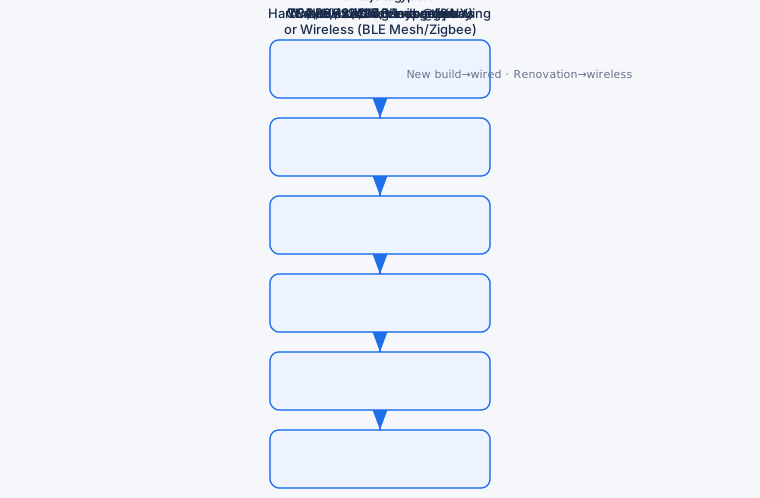
Hotel RCU Selection Decision Flow
The diagram below turns the checklist into a one-glance decision path.
Need a concrete proposal? See the HOTEKEY RCU page, the wired vs wireless explainer, or reach our engineering team with your room count and PMS brand.