Hotel RCU vs Smart Home Hub: The Short Answer
A hotel RCU (Room Control Unit) is a purpose-built controller installed one per guest room. It switches lighting, HVAC, curtains and scenes over a wired bus or wireless mesh, runs local logic that keeps working offline, and integrates with the hotel PMS for check-in scenes and room status. A smart home hub is a consumer device that links DIY devices to a vendor cloud and a mobile app — typically one per home, with no PMS interface and no hotel energy strategy. HOTEKEY has delivered 130,000+ guest rooms using RCU-based control.
What Is a Smart Home Hub?
A smart home hub (or gateway) is the centre of a consumer smart home ecosystem. It pairs with retail devices — smart bulbs, plugs, locks and sensors — usually over Wi-Fi, Zigbee or Bluetooth, and lets a resident create scenes and automations in a mobile app. Many ecosystems execute those scenes and cross-device routines in the vendor's cloud, with the app as the main control surface. This model works well for one home with one account. A hotel is a different animal: hundreds of rooms, a rotating stream of guest accounts, a front desk and a housekeeping team that all need to interact with the same rooms.
The Differences at a Glance
| Factor | Hotel RCU | Smart Home Hub |
|---|---|---|
| Deployment unit | One RCU per guest room, fleet-wide | One hub per home / unit |
| Control logic | Local logic on the room bus — works offline | Scenes and routines often executed in the vendor cloud |
| Hotel systems | PMS check-in / check-out scenes, room status sync | No PMS interface, no housekeeping workflow |
| Energy strategy | Keycard power, occupancy modes, unoccupied cut-off | Consumer automations, no hotel energy model |
| Permissions | Guest / front desk / engineering roles | Per-resident app account |
| Maintenance | Batch commissioning, room-type templates, fault monitoring | Per-home DIY pairing and app management |
Difference 1: Multi-Room Scale and Fleet Management
A hotel project is a fleet, not a gadget. Every room needs an identical control configuration, and operators commission, update and troubleshoot rooms in batches. HOTEKEY delivers RCU systems at hotel scale — a 168-room Four Points by Sheraton in Guangzhou, 249 keys across 13 room types in Shenzhen, and 92-room and 121-room BLE Mesh retrofits with mirror room-type templates and signed room-by-room acceptance. A consumer hub ecosystem is managed one home at a time in an app; there is no property-level commissioning, template or fault console. As of Oct 2022, 282 hotels / 45,000+ rooms are connected to HOTEKEY Cloud precisely because hotel operations require this fleet layer.
Difference 2: Offline Operation vs Cloud Dependency
The RCU runs its control logic on the room bus itself. Lighting, air conditioning, curtains and scenes execute locally, and the keycard power switch is hardwired to the room's loads. HOTEKEY Cloud handles remote monitoring and OTA configuration, but core room control keeps working if the internet drops. In many consumer ecosystems, scenes and cross-device automations run in the vendor cloud — convenient at home, but a hotel cannot have rooms go dark because a cloud service or the property's internet link is down. This is one of the most practical reasons hotels specify an RCU.
Difference 3: PMS Integration and Hotel Workflows
Hotel RCUs are engineered with PMS interfaces — over TCP/IP or serial RS-485 / Modbus through a gateway. At check-in the PMS sends the room-occupied event so the RCU runs the welcome scene; at check-out it switches to energy-saving mode and syncs room status (cleaning, fault) back to the front desk in real time. Service requests such as housekeeping and do-not-disturb flow to staff systems. Consumer hubs have no PMS protocol layer and no housekeeping concept — the two categories simply speak different languages. For the full event flow, see how an RCU works with the PMS.
Difference 4: Energy Strategy
Hotels manage energy per room, per occupancy state. The keycard switch cuts non-essential load when the guest leaves; occupancy modes relax the AC setpoint in unoccupied rooms; and the PMS energy mode takes over at check-out. This is a control policy built into the RCU layer, not an app automation a guest can switch off. Consumer hubs offer user-created automations, which are great at home but are neither enforceable nor reportable for a hotel's operations and cost accounting.
Difference 5: Permissions, Staff Roles and Maintenance
In an RCU system, the guest controls the room from wall panels; the front desk drives check-in events through the PMS; engineering monitors the whole property from the cloud console. Roles are separated by design. Consumer ecosystems assume one resident account owns everything — there is no guest-facing panel layer, no engineering console and no audit trail. Maintenance is the same story: hotels need batch firmware windows, room-type templates and fault alarms per room, not a DIY pairing flow.
Architecture Comparison
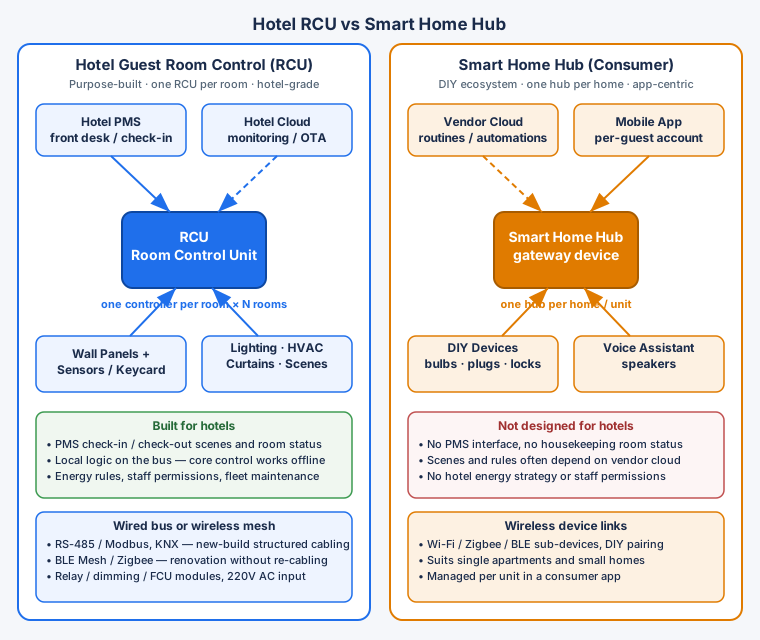
The diagram below contrasts the two architectures: a per-room RCU wired into hotel systems, versus a per-home consumer hub built around a vendor cloud and app.
When Is a Consumer Smart Home System Still a Fit?
Fairness matters: consumer hubs are excellent at what they were designed for. They fit single apartments, operator-owned long-stay units with light automation needs, and projects where a tenant's own app experience is the priority. Some hotels also mix categories — a consumer ecosystem in a staff office, or a vendor's speakers for in-room voice — alongside a proper RCU backbone. The category error is using a consumer hub as the hotel's room-control layer. For a deeper category-vs-category comparison, read Hotel RCU vs consumer smart home system.
Building or Renovating a Hotel?
If your project has a front desk, housekeeping team or PMS, start from the hotel-grade category. See what a hotel RCU is, compare the HOTEKEY RCU product line, review the smart hotel solution, or explore wired vs wireless options for your build type.