
What Is a Hotel RCU?
A hotel RCU (Room Control Unit) is the embedded controller installed in each guest room that centrally manages lighting, air conditioning, curtains, scenes and service requests. It reads wall panels and sensors, runs local logic, and talks to the hotel PMS and cloud so rooms respond automatically at check-in and save energy when unoccupied. HOTEKEY has delivered 130,000+ guest rooms and connects 282 hotels / 45,000+ rooms to HOTEKEY Cloud.
Think of the RCU as the "brain" of the guest room. Founded in 2013 and headquartered in Guangzhou, Guangzhou Hotekey Electronics Co., Ltd. (HOTEKEY) builds RCU controllers that sit between the guest-facing switches and the room's electrical loads, executing scenes and energy rules without asking the cloud for permission on every action.
Where Is the RCU Installed?
The RCU is typically mounted inside the room's electrical / weak-current distribution box — above the ceiling or inside a wall cabinet — so it stays hidden from guests. Hotels install one controller per room (or one per suite zone). It is powered from the room's 220V AC supply and wired to the panels, the controlled loads and the communication bus.
- Place the controller in the standard room distribution box; keep bus runs away from high-current cable trunks.
- Use shielded communication cable and a clean 220V feed; terminate the bus with 120 Ω resistors at both ends.
- Assign a unique address to every RCU before it joins the bus — this is what makes room-by-room control and fault isolation possible.
What Does a Hotel RCU Control?
The RCU switches and dims the devices a guest actually touches and the systems the operator wants to manage:
| Function | What the RCU does |
|---|---|
| Lighting | On/off, 0-10V dimming and scene presets across the room. |
| HVAC | Drives the fan coil / AC through FCU modules and holds the temperature setpoint, with occupancy-based modes. |
| Motorised curtains | Opens and closes curtains on schedule or by scene. |
| Scenes | Welcome, away, sleep and do-not-disturb presets triggered by card, time or PMS event. |
| Service requests | Housekeeping, bellboy and do-not-disturb calls routed to the front desk. |
| Keycard power | The card-insertion switch powers the room when occupied and cuts load on departure. |
HOTEKEY RCU modules are offered in 4 / 8 / 12 / 17 relay channels at 16A, with 0-10V dimmers, dry-contact modules and FCU (fan-coil) modules, plus gateways — so one architecture scales from a compact room to a full floor.
How the RCU Relates to Panels, Sensors, PMS and Cloud
The RCU is the hub of a small local system:
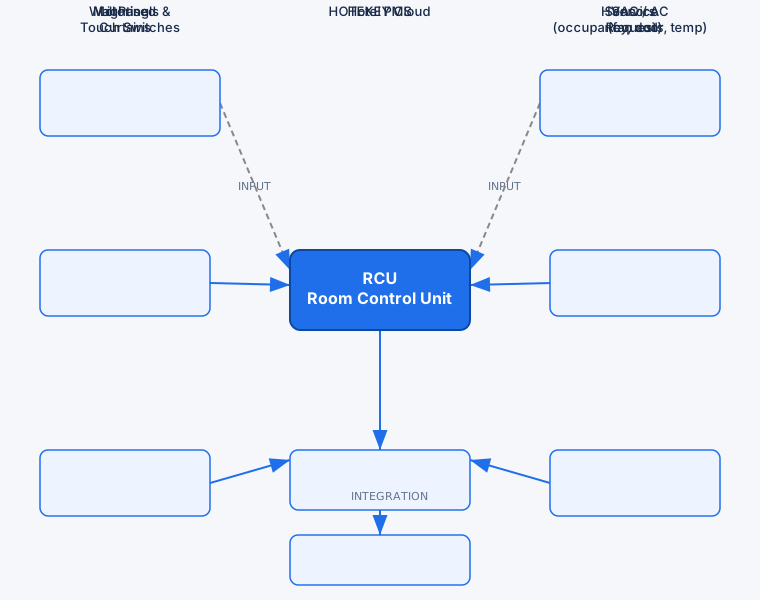
- Wall panels / touch switches are the guest's input — every press is an event the RCU interprets.
- Sensors (occupancy, door, temperature) feed local logic so the room reacts without cloud latency.
- PMS integration: at check-in the PMS tells the RCU the room is occupied and the welcome scene runs; at check-out it switches to energy-saving mode and syncs room status (cleaning, fault) back to the front desk in real time.
- HOTEKEY Cloud: remote monitoring, OTA configuration and analytics. As of Oct 2022, 282 hotels / 45,000+ rooms are connected to HOTEKEY Cloud.
Crucially, the RCU runs local logic first. Core room control keeps working if the internet drops; PMS sync and cloud features resume when the link is restored.
Hotel RCU System Architecture
The diagram below shows how the RCU sits between guest input, in-room loads and the hotel's management layer.
Wired vs Wireless RCU
Both are HOTEKEY product lines; the choice is a project decision, not a brand one.
| Factor | Wired (RS-485 / Modbus, KNX) | Wireless (BLE Mesh, Zigbee) |
|---|---|---|
| Best for | New-build, structured cabling | Renovation / occupied hotels |
| Latency & robustness | Low latency, strong anti-interference | Good for retrofit, no re-cabling |
| Cost driver | Cabling labour in construction | Device count, no rewiring |
New-build hotels with structured cabling usually choose wired RS-485 / Modbus or KNX for robustness and low latency. Occupied-hotel renovations choose wireless BLE Mesh or Zigbee to avoid re-cabling entirely — HOTEKEY has delivered 92-room and 121-room BLE Mesh retrofits. Many projects run a hybrid: a wired backbone plus wireless zones.
Common RCU Specifications
- Relay outputs: 4 / 8 / 12 / 17 channels at 16A (module options).
- Dimming: 0-10V dimmers for scene lighting.
- Modules: dry-contact modules, FCU (fan-coil) modules, gateway / switch modules.
- Communication: RS-485 / Modbus, KNX, BLE Mesh, Zigbee; TCP/IP and MQTT via gateways.
- Power & mounting: 220V AC input, mounted in the standard room electrical box.
Ready to size an RCU for your rooms? See the HOTEKEY RCU page, the guest room control system explainer, or how to select an RCU. For the PMS link, read RCU and PMS integration.