
What Is Modbus (RS-485) in Hotel Automation?
Modbus over RS-485 is the wired bus protocol behind most HOTEKEY guest-room control in new-build and large hotels. A single shielded twisted pair links every room controller (RCU), dimmer and relay to one RS-485 trunk, addressed 1–247, running up to 1200 m at 9600 bps. It is deterministic, immune to Wi-Fi congestion, and keeps lighting, HVAC and curtains working even when the network or cloud is down — ideal where hundreds of rooms must act as one system.
Modbus is an open, decades-old industrial communication protocol; RS-485 is the physical two-wire bus it commonly runs on. In a hotel, HOTEKEY uses Modbus RTU over RS-485 to connect each room's loads — lighting, air conditioning, curtains, service requests — to a central controller, so one cable plant serves the whole floor instead of a star of point-to-point wires.
How the RS-485 Bus Topology Works
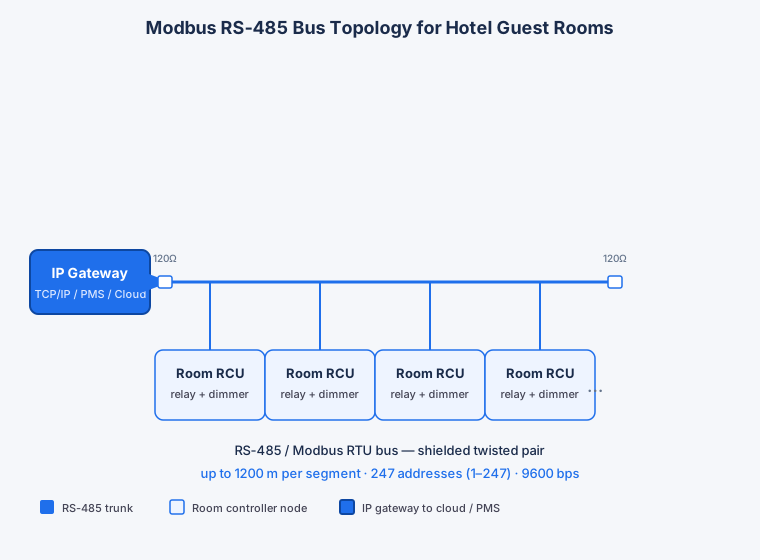
The bus is a daisy-chain (hand-in-hand) trunk: every device taps the same two wires. Only the first and last node carry a 120 Ω termination resistor; intermediate devices bridge straight onto the pair. Each RCU or module gets a unique Modbus address (1–247), and a single IP gateway converts the bus to TCP/IP / MQTT for the PMS and cloud. The diagram below shows one gateway feeding a shared trunk with one RCU per room.
Wiring & Installation
- Use shielded twisted-pair cable and keep the bus away from high-current runs (elevators, compressor rooms, dimmer feeds).
- One segment reaches up to 1200 m at the standard 9600 bps hotel setting; extend further with repeaters or split floors into separate bus runs.
- Modules mount on standard DIN rail inside the room distribution box and are set by DIP switch or tool — no per-device software pairing needed.
- Terminate both ends with 120 Ω resistors and verify the shield is grounded at one point only to avoid ground loops.
Why Hotels Choose RS-485 / Modbus: Stability
RS-485 is differential (balanced) signalling: the receiver reads the voltage difference between the two wires, not their absolute level, so it rejects the electrical noise from elevators, compressors and dimmers that corrupts single-ended lines. Combined with correct shielding, grounding and termination, that gives the industrial-grade, 7×24 stability a hotel needs. Crucially, room logic runs locally on the bus — if the IP link drops, lighting, AC and curtains keep working, and PMS sync resumes when the link returns.
Where It Fits: New Builds & Large Room Counts
RS-485 / Modbus shines when the building already has, or is getting, structured low-voltage cabling:
| Scenario | Why RS-485 / Modbus fits |
|---|---|
| New-build hotels | Cabling is planned during construction; one trunk serves a whole floor at low cost. |
| Full renovations | Cable is pulled room-by-room anyway, so the bus installs cleanly. |
| Large room counts | Up to 247 addresses per bus and segmented runs scale to hundreds of rooms. |
| High-interference sites | Differential signalling stays reliable near plant rooms and lifts. |
Modbus vs KNX vs BLE Mesh: Division of Labour
All three are HOTEKEY product lines; the choice is a project decision, not a brand one.
| Factor | RS-485 / Modbus | KNX | BLE Mesh |
|---|---|---|---|
| Best for | New build, large room counts | Open-standard luxury / long-life | Occupied renovation, no rewiring |
| Engineering effort | Low (2-wire bus) | Higher (certified topology) | Low (wireless commissioning) |
| Node capacity | 247 / bus segment | Up to 64,000 (multiple segments) | Hundreds per mesh |
| Wireless? | No | No | Yes |
| Cloud / PMS bridge | Via IP gateway | Via IP gateway | Via gateway |
Many hotels run a hybrid: RS-485 for room-level control and KNX for public areas, with BLE Mesh zones in later renovated floors. Gateways bridge any of them to the same PMS and HOTEKEY Cloud.
HOTEKEY Modbus Room Control
HOTEKEY's Mod-BUS series builds the room controller from proven modules: 4 / 8 / 12 / 17-channel 16A relays, 2- and 4-channel 0-10V dimmers, FCU (fan-coil) modules, curtain modules, dry-contact modules and an IP gateway. That one architecture scales from a compact room to a full floor. HOTEKEY has delivered 130,000+ guest rooms and connects 282 hotels / 45,000+ rooms to HOTEKEY Cloud (as of Oct 2022).
Compare it with KNX on KNX vs RS-485 / Modbus, or weigh wired against wireless on wired vs wireless hotel control. To size a bus for your project, see how to choose a hotel RCU and the HOTEKEY RCU page, or start from the Mod-BUS series overview.