
What Is Hotel Room Energy Management and Why Does It Cut Costs?
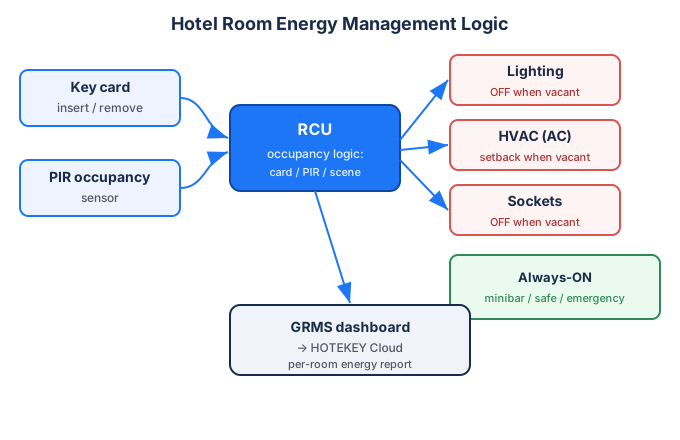
Hotel room energy management means the RCU trims the three biggest in-room loads — lighting, HVAC and plugged-in devices — to what occupancy actually requires, so a typical property cuts 10–30% of guest-room energy without changing comfort. The RCU is the executor: a key-card switch, a PIR sensor and scene presets decide which loads run, and the GRMS layer logs the result per room. For a 200-room property this is not a rounding error — the avoided kWh move the payback math on their own. HOTEKEY applies the same occupancy logic across both its wired Mod-BUS RCU line and its wireless J26 BLE Mesh line, so the saving holds whether the building was cabled at build or retrofitted around live guests.
How Does Card-Power (Key Card Switch) Save Energy?
The energy-saving key-card switch is the single biggest lever in a guest room: pulling the card drops lighting, TV and non-essential sockets to off or standby the instant the guest leaves, while the minibar, safe and emergency circuits stay live. Every RCU HOTEKEY ships includes card-power logic as standard, validated against the PMS stay record so an unregistered card cannot keep a room energised — which also closes the revenue-leakage gap the anti-room-hopping solution targets. One action, no staff involvement, removes the load that otherwise runs all day behind an empty room. In a property running on HOTEKEY Cloud, the card event also feeds the per-room energy report, so engineering sees exactly when each room went idle.
How Does Occupancy-Based HVAC Setback Work?
On card-remove or PIR timeout the RCU moves the thermostat to a milder setback setpoint — enough to protect the room from heat, humidity or freezing, but far below the comfort cooling or heating it would run for an occupied guest. Comfort is restored automatically on return, so the guest never walks into a stuffy or cold room. HVAC is the dominant load in most guest rooms, and tying it to occupancy is where the largest saving sits: 15–30% off room air-conditioning is typical, and in tropical markets the avoided kWh are large enough to change the business case. HOTEKEY's wired and wireless RCUs both carry the setback logic locally, so the AC keeps saving even if the network link drops.
What Role Do Lighting Scenes and Curtains Play?
Lighting scenes stop every fixture being on at once: a "leave" scene kills the lights, a "sleep" scene drops to a bedside path, and daylight-aware curtain logic cuts summer cooling load or harvests free winter heat. Corridor and public-area dimming over DALI or 0–10V trims standby waste that accumulates across a whole floor. None of this needs a guest to think about it — the RCU runs the scene from the card and sensor state. HOTEKEY's KNX panels and wireless BLE switches share the same scene engine, so a property can mix wired guest rooms and wireless refits under one energy policy.
How Do You Measure and Verify the Savings?
A GRMS dashboard turns energy saving from a policy into a measured system: it reports consumption per room and compares before-versus-after totals, so a stuck relay or an always-on unit shows up the day it happens rather than at the quarterly audit. The same data supports a defensible payback figure for owners and a maintenance cue for engineering. HOTEKEY's cloud normalises these readings across wired and wireless rooms into one report, which is also what the Mongolia hotel PMS integration project used to keep room status and consumption on the same screen as the front desk.
What Is the Payback Period for a Hotel Energy Upgrade?
Because HOTEKEY ships both wired and wireless RCU lines behind one cloud platform, most occupied renovations reach payback in 1–3 years from HVAC setback and card-power savings alone, before counting lighting and maintenance gains. Wireless BLE Mesh refits avoid rewiring cost entirely, which shortens the clock further on operating properties. With 130,000+ guest rooms delivered and 282 hotels / 45,000+ rooms on HOTEKEY Cloud (as of Oct 2022), the occupancy logic is proven across climates from tropical resorts to four-season city hotels — the variable is tariff and climate, not whether the saving exists. To scope an upgrade, start from how to choose a hotel RCU and the what is a hotel RCU baseline.