
Can You Retrofit a Hotel Without Rewiring the Guest Rooms?
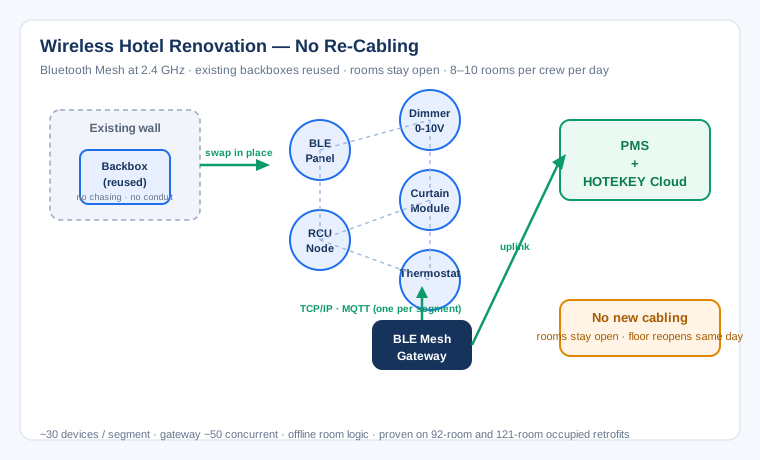
Yes. A wireless (Bluetooth Mesh / BLE Mesh) retrofit reuses the existing electrical layout — panels and RCU nodes mount on the current boxes and backboxes, so crews convert rooms without chasing walls, pulling conduit or closing floors for cabling. That is the decisive difference from a wired RS-485 or KNX upgrade, where control cabling has to be run through occupied floors. HOTEKEY has shipped this in occupied hotels where pulling cable would force rooms out of service, and it now complements the company's wired ranges as the renovation-first option. The result: the guest room control system is modernised while the floor keeps selling rooms.
Why Rewiring Destroys Renovation Budgets and Occupancy
The hidden cost of a wired retrofit is not the cable itself — it is the lost room nights. Pulling control cabling through occupied floors means opening walls, scheduling floor-by-floor closures, and taking sellable rooms offline while the work is done. A 100-room wired retrofit can lose weeks of revenue per floor, and that lost occupancy often dwarfs the material cost of the wire. Bluetooth Mesh removes that line item: crews swap faceplates and mount RCU nodes in place, and each floor reopens independently the same day. For an operating hotel, eliminating closures is usually a larger saving than the cabling labour itself.
How Wireless BLE Mesh Room Control Works in a Renovation
Bluetooth Mesh is the wireless room-control protocol on Bluetooth Low Energy at 2.4 GHz. Every in-room device — switch panel, RCU, dimmer, curtain module, thermostat, door sensor — is a node that both uses and relays messages, so a command hops through neighbours without a central hub or per-room router. A single Bluetooth Mesh gateway per segment bridges the local mesh to TCP/IP / MQTT for the PMS and HOTEKEY Cloud. Because room logic runs locally on the nodes, lights, AC and curtains keep working even if the IP link or cloud drops, and re-sync when the link returns. For a renovation, the only hardware change is the faceplate and the in-room RCU node; the lighting and AC circuits they already control stay exactly where they are.
BLE Mesh vs Wired Retrofit — What You Actually Save
The two architectures you actually choose between, on the factors that decide a renovation:
| Factor | BLE Mesh (wireless) | RS-485 / KNX (wired) |
|---|---|---|
| Rewiring | None | Required |
| Room closures | None — floor reopens same day | Floor-by-floor closures |
| Install speed | 8–10 rooms / crew / day | With electrical rough-in |
| Node capacity | ~30 / segment, gateway ~50 concurrent | 32 RCU nodes / RS-485 bus |
| Offline operation | Local node logic | Local bus logic |
| Best fit | Occupied renovation | New build |
Both run the room logic locally, so in-room reliability is comparable; for a renovation the choice is decided by cabling and closures, not by radio.
Delivered Proof — 92-Room and 121-Room Occupied Retrofits
The theory is already in service. The Zhuangduo Hotel in Xintang, Guangzhou retrofitted 92 occupied rooms with Bluetooth Mesh guest room control and no re-cabling, reopening in August 2026. The Mehood Lestie Hotel in Zengcheng covered 121 rooms — including AC, motorised curtains and voice control — completed September 2026. Both used HOTEKEY's J26 series and stayed open throughout the rollout. Across its product lines HOTEKEY has delivered 130,000+ guest rooms and connects 282 hotels / 45,000+ rooms to HOTEKEY Cloud (as of Oct 2022) — the J26 series alone now underpins two delivered occupied retrofits of 92 and 121 rooms.
ROI — How Fast Wireless Renovation Pays Back
The payback case is driven by two removed cost lines: eliminated wiring labour and eliminated lost room nights. Because there is no conduit or wall chasing, the per-room install labour drops sharply versus a wired retrofit, and because rooms never close, the renovation adds revenue instead of subtracting it. Most operators model payback in months, not years — the exact number depends on room count, building type (occupied / heritage / phased) and PMS brand, which is why HOTEKEY returns a BOM and a costed proposal within two working days. The wireless retrofit is the rare upgrade where the disruption it avoids is itself a large part of the return.
Where Wireless Renovation Fits Best
When the constraint is "cannot cable" rather than budget, BLE Mesh is the right call:
| Scenario | Why BLE Mesh fits |
|---|---|
| Occupied hotel renovation | No closure for cabling; each floor reopens independently. |
| Heritage / leased buildings | Cabling is restricted, so a wireless layer avoids structural change. |
| Phased rollout | Convert some floors now; expand the mesh later. |
| Event / conference wings | Fast, reversible deployment for temporary high-occupancy zones. |
| Hybrid zones | Wireless extension where a wired backbone exists but areas can't be cabled. |
HOTEKEY J26 Series — Wireless Renovation-Ready Room Control
HOTEKEY's J26 series is the Bluetooth Mesh room-control line built for exactly these projects: wireless BLE panels, RCU nodes, dimmers, curtain modules and thermostats that commission floor-by-floor and bridge to the same PMS and HOTEKEY Cloud as the wired ranges. Compare the trade-off on wired vs wireless hotel control, size a project on how to choose a hotel RCU, or read the delivered Zhuangduo Hotel and Mehood Lestie case studies. For a renovation-first supplier, HOTEKEY has delivered 130,000+ guest rooms across 282 hotels on its cloud platform.