
What Is BLE Mesh Hotel Room Control?
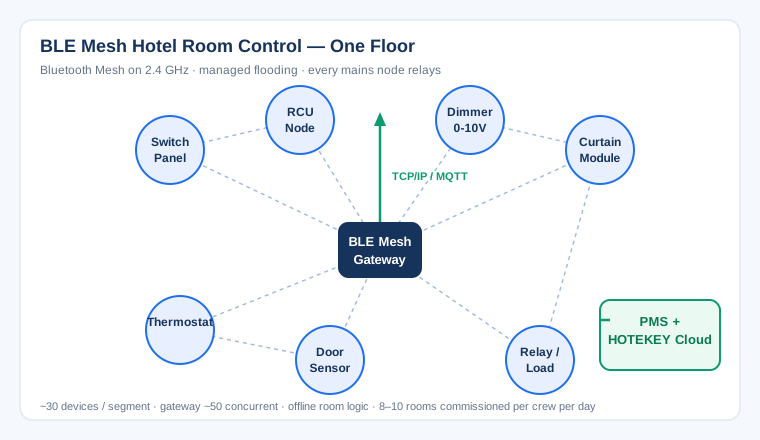
BLE Mesh — Bluetooth Mesh, the SIG's mesh networking profile on Bluetooth Low Energy at 2.4 GHz — is the wireless room-control protocol HOTEKEY uses to connect in-room devices without dedicated control cabling. Every device (switch panel, RCU, dimmer, curtain module, thermostat, door sensor) is a "node" that both consumes and relays messages, so a command from one panel reaches a distant load by hopping through neighbours instead of travelling to a central hub. That self-healing, many-to-many topology is why a BLE Mesh floor keeps working even when a single node fails. HOTEKEY has shipped it in occupied hotels where pulling cable would force rooms out of service, and it now complements the company's wired RS-485 and KNX ranges as the renovation-first option.
How Bluetooth Mesh Works in a Hotel Room
Bluetooth Mesh uses managed flooding: when a guest presses a switch, the mesh "publishes" a state message (for example "light on, scene 1") that every node within radio range receives and re-broadcasts once, so the message propagates across the floor without a star topology or a per-room router. Nodes subscribe to the states they act on — a dimmer to "brightness", a curtain module to "open/close" — so one command travels through the network to exactly the loads that need it. Because every mains-powered device relays, radio coverage extends as powered nodes are added, and a shared network key keeps the floor private. Each node is provisioned over a secure bearer before it can send or receive, which is the "commissioning" step engineers run floor by floor.
The Gateway's Role: Bridging Mesh to TCP/IP, PMS and Cloud
The mesh itself is local and offline-capable; a BLE Mesh gateway is the single bridge that translates mesh messages to TCP/IP / MQTT for the PMS, HOTEKEY Cloud and the front desk. The gateway binds scenes (check-in / check-out / do-not-disturb), forwards room status upstream and pushes OTA configuration down. Field planning numbers keep a Bluetooth Mesh segment to roughly 30 devices and one wireless gateway handling about 50 concurrently controlled devices; beyond that you add a gateway and partition the floor. Crucially, room logic runs locally on the nodes, so if the IP link or cloud drops, lights, AC and curtains keep working and re-sync when the link returns.
No Rewiring: Why BLE Mesh Suits Occupied Renovations
The decisive advantage is the absence of control cabling. A BLE Mesh retrofit reuses the existing electrical layout — panels and RCU nodes mount on the current boxes and backboxes, so crews convert rooms without chasing walls, pulling conduit or closing floors for cabling. The Zhuangduo Hotel in Xintang, Guangzhou retrofitted 92 occupied rooms with no re-cabling and reopened in August 2026; the Mehood Lestie Hotel project covered 121 rooms including voice control. A crew typically converts 8–10 rooms per day, each floor reopened independently, so rooms stay sellable during the rollout — the disruption that kills wired retrofits never appears.
Latency and Stability: Wired vs BLE Mesh
A quick planning comparison of the two architectures you actually choose between:
| Factor | BLE Mesh (wireless) | RS-485 / KNX (wired) |
|---|---|---|
| Backbone | 2.4 GHz radio, no cable | Shielded bus cable |
| Rewiring | None | Required |
| Node capacity | ~30 / segment, gateway ~50 concurrent | 32 RCU nodes / RS-485 bus (repeater beyond) |
| Offline operation | Local node logic | Local bus logic |
| Best fit | Occupied renovation | New build |
| Typical speed | 8–10 rooms / crew / day | With electrical rough-in |
Both run the room logic locally, so in-room reliability is comparable; the choice is decided by cabling, not by radio.
Where BLE Mesh Fits Best
BLE Mesh is the right call when re-cabling is the constraint, not the budget:
| Scenario | Why BLE Mesh fits |
|---|---|
| Occupied hotel renovation | Convert rooms with no closure for cabling; each floor reopened independently. |
| Heritage or leased buildings | Cabling is restricted, so a wireless layer avoids structural change. |
| Phased rollout | Only some floors converted now; expand the mesh later. |
| Event / conference wings | Fast, reversible deployment for temporary high-occupancy zones. |
| Hybrid zones | Wireless extension where a wired backbone already exists but specific areas can't be cabled. |
BLE Mesh vs KNX vs RS-485: Division of Labour
All three are HOTEKEY product lines; the choice is a project decision, not a brand one.
| Factor | BLE Mesh | KNX | RS-485 / Modbus |
|---|---|---|---|
| Best for | Occupied renovation, no rewiring | Open-standard luxury / long-life | New build, large room counts |
| Backbone | 2.4 GHz wireless | Certified bus cable | 2-wire bus cable |
| Node capacity | ~30 / segment, gateway ~50 | Up to 64,000 (multi-segment) | 247 / bus segment |
| Cloud / PMS bridge | Via gateway | Via IP gateway | Via IP gateway |
Many hotels run a hybrid: a wired backbone in constructed areas, BLE Mesh in later renovated floors, all bridged to the same PMS and HOTEKEY Cloud.
HOTEKEY J26 Series BLE Mesh Room Control
HOTEKEY's J26 series is the Bluetooth Mesh room-control line built for exactly these projects: wireless BLE panels, RCU nodes, dimmers, curtain modules and thermostats that commission floor-by-floor and bridge to the same PMS and HOTEKEY Cloud as the wired ranges. Across its product lines HOTEKEY has delivered 130,000+ guest rooms and connects 282 hotels / 45,000+ rooms to HOTEKEY Cloud (as of Oct 2022); the J26 series alone accounts for 92-room and 121-room occupied retrofits already in service. See the J26 range on the Wireless BLE series page, compare it with wired on wired vs wireless hotel control, or size a renovation on how to choose a hotel RCU. For delivered proof, read the Zhuangduo Hotel and Mehood Lestie case studies.