
What Does PMS Integration Actually Do in a Guest Room Control System?
The short answer: PMS integration keeps the hotel's management system and the physical rooms in sync, so a front-desk action and a room sensor each set off the correct downstream scene. The PMS remains the single source of truth for reservations; the room control system is the executor and the sensor network. Every HOTEKEY RCU reports to HOTEKEY Cloud, and the cloud exchanges events with the PMS. Concretely that means a check-in triggers the welcome scene, a check-out switches everything off, and housekeeping and engineering see live room status — without a receptionist re-typing the same data into two systems. For a property running on a HOTEKEY RCU platform, this is the difference between "rooms we hope are correct" and a room state the whole hotel can trust.
How Does the RCU Reach the PMS? HOTEKEY Cloud as the Bridge
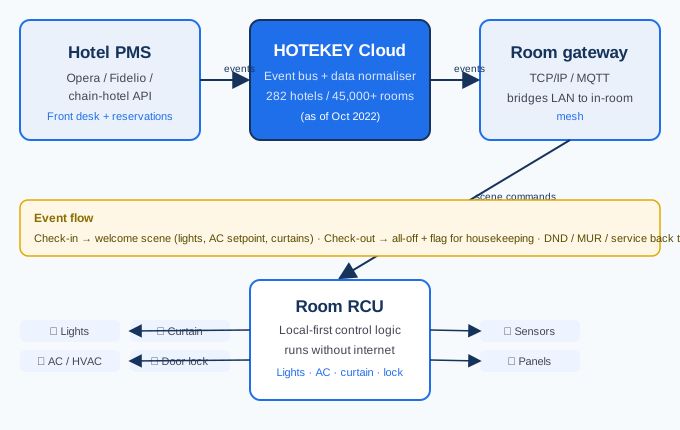
The RCU does not talk to the PMS over a cable — it reaches it through an integration layer. Each HOTEKEY RCU runs local control logic and reports to HOTEKEY Cloud, which normalises room data and exposes standard events to the PMS over TCP/IP or a serial link. This cloud bridge is deliberate: it lets one room-control platform interface with many different PMS products without rewriting the RCU firmware for each hotel. Local room control stays on the RCU and the gateway, so lighting, curtain and HVAC keep working during an internet outage and re-sync when the link returns. As of Oct 2022, 282 hotels / 45,000+ rooms run on HOTEKEY Cloud — but the core in-room logic is local-first on every protocol the company ships, wired or wireless.
Which PMS Platforms Can HOTEKEY Integrate With?
HOTEKEY integrates with mainstream hospitality PMS platforms — including Opera / Fidelio class systems and chain-hotel APIs — over TCP/IP or serial links, with the interface parameters agreed per property. The integration is protocol-level, not brand-level: the cloud side exposes standard events (reservation change, room status, service request) and maps them to whichever PMS interface the hotel uses. For a chain property the chain's own API is used; for an independent hotel the property's PMS vendor supplies the interface document and HOTEKEY completes the mapping. This is the same approach behind the delivered Mongolia hotel PMS integration project, where an RS-485 / Modbus room-control architecture was wired to the local PMS in real time.
What Data Flows Between the PMS and the Room Control System?
Three event families move across the integration, and they map directly to daily hotel operations. Reservation events — check-in, check-out and room move — drive room scenes from the front desk. Room status events — do-not-disturb, make-up-room and maintenance — flow from the rooms back to the PMS console, so reception and housekeeping always see the same picture. Energy data accumulates into per-room reports alongside occupancy, giving engineering a consumption baseline per room type. HOTEKEY's own figures make the scale concrete: 130,000+ guest rooms delivered and 282 hotels / 45,000+ rooms on HOTEKEY Cloud, all reporting through the same event model rather than disconnected spreadsheets.
What Happens at Hotel Check-In and Check-Out?
The most visible benefit of the integration is the automatic scene. At check-in the PMS marks the room occupied and HOTEKEY Cloud pushes a welcome scene to the RCU — selected lights on, the AC to its default setpoint, curtains open. In the room, the keycard, door sensor and panel commands are executed locally by the RCU with no round trip to the cloud. At check-out the PMS posts the departure, the RCU switches loads off and flags the room for housekeeping, and do-not-disturb, make-up-room and maintenance alerts continue to flow from the RCU to the PMS console. Staff never duplicate entries in two systems, and a room never sits "occupied" on one screen while housekeeping sees it as "available".
Room Status Not Syncing After Go-Live — What to Check?
Most go-live sync failures are interface parameters or room-number mapping, not broken links, so the fix is methodical rather than random. Confirm the network path and that the PMS server accepts connections from the cloud integration; verify the protocol parameters (IP, port, protocol type — TCP/IP or serial) against the interface document; test one room end to end (check-in to welcome scene to status back); then audit the room-number mapping table for the remaining rooms. Duplicated or shifted room numbers are the most frequent fault on multi-building properties, where building prefixes get dropped. This four-step sequence, documented at handover, is also the first thing a HOTEKEY field engineer runs before touching any device.
Can the System Support Self Check-In and Unattended Operation?
Yes — the same event chain supports unattended operation when it is linked with self check-in kiosks and smart locks. The guest completes check-in, receives an authorised card or mobile key, and the room prepares itself on first entry: on first unlock the RCU recognises the authorised card and runs the welcome scene, while the PMS sees the occupied status without any front-desk action. The same integration supports remote pre-conditioning, where the front desk starts the AC before an arriving guest reaches the room. For hotels pushing contactless arrival, this closes the loop between the PMS, the lock and the RCU without adding a separate controller or a cloud dependency that breaks offline.
How Is a PMS Integration Project Tested and Handed Over?
Integration is accepted with a written test matrix rather than a handshake. Every event type — check-in, check-out, DND, make-up-room and service call — is triggered in both directions on sample rooms, then on a full floor, before the whole property goes live. Handover includes three documents any future engineer needs: the interface parameter sheet, the room-number mapping table, and the scene configuration backup. That documentation is what keeps a PMS link maintainable years later, and it is exactly how the Mongolia hotel PMS integration project was delivered with the local integrator. To scope an integration for your property, start from how to choose a hotel RCU and the what is a hotel RCU baseline.