
What Is the Difference Between Zigbee and Bluetooth Mesh in a Hotel?
The two are siblings, not rivals: both are 2.4 GHz ISM-band mesh protocols whose in-room devices relay messages through neighbours, and both need a gateway to bridge the local mesh to the LAN, the PMS and the cloud. The difference a hotel actually feels is three numbers and one install method. Zigbee 3.0 moves data at 250 Kbps and supports up to 250 nodes per network, and it is the more established low-power mesh — battery-friendly end devices make it strong in sensor-heavy installs. Bluetooth Mesh (BLE 5.0) moves data at 2 Mbps (roughly 8× the throughput) and supports up to 200 nodes, and its switches replace the existing faceplate and re-use the lighting circuit, so no new control cable is pulled. Both avoid the RS-485 / KNX bus cabling of wired control; the split is "low-power, coordinator-managed" versus "high-throughput, direct-replacement".
Zigbee 3.0 for Hotel Room Control — Throughput, Nodes and Power
Zigbee 3.0 is the mature, low-power member of the pair. Its headline numbers from HOTEKEY's wireless Zigbee series are a 250 Kbps data rate, a 100 m max transmission distance per hop, and a 250-node network ceiling, running on DC 3.3 V / 5 V / 12 V so battery-powered sensors and end devices stay practical. It forms a self-healing mesh of coordinator, routers and end devices, so a single failed node re-routes without taking the room offline. Its operating window is -10 ℃ to +50 ℃ at IP20, which suits indoor guest-room panels and sensors. The trade the hotel pays is lower throughput — fine for switching and sensing, less ideal when a room pushes firmware or media-heavy traffic. For a large new-build where a coordinator-managed low-power mesh and long battery life are valued, Zigbee 3.0 is the conservative, proven choice.
Bluetooth Mesh (BLE 5.0) for Hotel Room Control — Speed and No New Wiring
Bluetooth Mesh (BLE 5.0) trades a little node headroom for much higher throughput and the easiest install of the two. HOTEKEY's BLE J26 series runs at 2 Mbps with a 200-node ceiling and a 100 m max hop, on DC 12 V / 24 V, and it works across a wider -20 ℃ to +60 ℃ range. The decisive property is the install: every smart switch directly replaces a traditional switch and re-uses the existing lighting circuit, so there is no new control wiring and rooms stay in service — the same property that let HOTEKEY convert occupied hotels at 8–10 rooms per crew per day. Every mains-powered node relays, so the network self-heals around a failed device. Where Zigbee wins on battery life, BLE Mesh wins on throughput and drop-in retrofit speed.
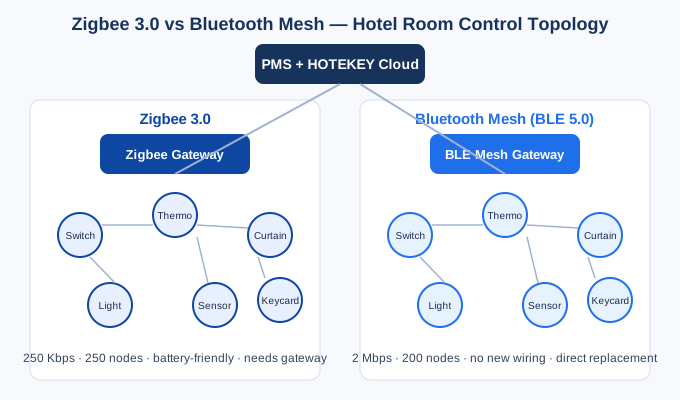
Zigbee vs BLE Mesh — Side-by-Side Comparison Table
The factors that decide a hotel wireless rollout, placed in one table:
| Factor | Zigbee 3.0 | Bluetooth Mesh (BLE 5.0) |
|---|---|---|
| Frequency band | 2.4 GHz ISM | 2.4 GHz ISM |
| Data rate | 250 Kbps | 2 Mbps |
| Max nodes / network | 250 | 200 |
| Max range per hop | 100 m | 100 m |
| Topology | Self-healing mesh (coordinator + routers + end devices) | Self-organizing mesh (every mains node relays) |
| Wiring | Gateway required; battery-friendly low-power devices | No new control wiring; switch replaces existing faceplate |
| Operating power | DC 3.3 V / 5 V / 12 V | DC 12 V / 24 V |
| Operating temperature | -10 ℃ ~ +50 ℃ (IP20) | -20 ℃ ~ +60 ℃ |
| Best fit | Large new builds, sensor-heavy, low-power | Occupied renovation, fast retrofit, high throughput |
| HOTEKEY line | Wireless Zigbee series | BLE J26 series |
Both reach the PMS and cloud through a gateway, and both run room logic locally, so in-room reliability is comparable; the table separates them on throughput, install method and device power.
Do Both Wireless Protocols Need a Gateway to Reach the PMS and Cloud?
Yes — this is the one thing that does not change between the two. Zigbee and Bluetooth Mesh are both local mesh radios; their in-room devices talk to each other directly, but to reach the LAN, the hotel PMS and HOTEKEY Cloud they each need a gateway that translates mesh messages to TCP/IP / MQTT. On both, scene logic and local control run on the gateway and the devices themselves, so lighting, curtain and HVAC control keep working during an internet outage and re-sync when the link returns. As of Oct 2022, 282 hotels / 45,000+ rooms run on HOTEKEY Cloud — but the core room control is local-first on either protocol. The practical takeaway: pick the radio for throughput and wiring, then expect the same gateway-plus-PMS architecture regardless.
Retrofit vs New Build — Where Zigbee and BLE Mesh Each Fit Best
The install method is where the two diverge for a hotel's bottom line. Bluetooth Mesh needs no new control cable — its switches drop into the existing box and re-use the lighting circuit — so an occupied renovation keeps selling rooms and a crew converts roughly 8–10 per day, the pattern behind HOTEKEY's delivered 92-room and 121-room occupied retrofits. Zigbee also avoids bus cabling, but its edge is low-power, battery-friendly sensors and the larger 250-node ceiling, which pays off in new builds and large sensor networks more than in a fast occupied flip. For a new building with no occupancy pressure, either works; for a hotel that cannot close rooms, BLE Mesh's direct replacement is the lower-risk call. Hybrid sites often run BLE Mesh in the renovated wing and Zigbee in the new tower, both reporting to one PMS.
HOTEKEY Ships Both Zigbee and BLE — One Supplier, One PMS
HOTEKEY supplies a complete Zigbee 3.0 wireless series and the BLE J26 series for hotel room control, and both integrate to the same PMS and HOTEKEY Cloud with one after-sales contact — so switching the radio does not mean switching the vendor or the management layer. Across its product lines the company has delivered 130,000+ guest rooms and connects 282 hotels / 45,000+ rooms to HOTEKEY Cloud (as of Oct 2022). Compare the two lines on HOTEKEY Wireless Zigbee and HOTEKEY Wireless BLE (J26), read how a wireless renovation runs without rewiring, or size a project on how to choose a hotel RCU.